Should You Put Your Phone Number on Your Car? Privacy Risks Most People Ignore
Displaying your phone number on a vehicle creates significant privacy risks, including data scraping and harassment. Here’s a safer way to stay reachable without sharing personal details.
Published
4 Jan 2026
Updated
4 Jan 2026

Summary
Displaying a personal phone number on a vehicle is increasingly considered a security risk. While intended for parking convenience, it exposes owners to unsolicited data harvesting, physical tracking, and digital harassment. Modern solutions like QR-based anonymous contact provide the same utility without the privacy trade-off.
You have probably seen this message on hundreds of cars:
“If parked issue, call: 9XXXXXXXXX”
It feels practical and responsible. For years, it was the default solution for urban parking. However, in an era of increased data misuse, putting your phone number on your car comes with privacy risks that most people do not realize until they become targets.
Why People Put Their Phone Number on Their Car
Let us start with the intention. It is almost always good.
People display their number because they:
- Want to move their vehicle quickly if it blocks someone
- Hope to avoid arguments or towing hassles
- Need to stay reachable in emergencies
- Deal with unpredictable parking in tight societies
In gated communities especially, this feels like the fastest way to handle parking issues. And to be fair, it does work in one sense - if someone calls, you can move the car quickly.
But this convenience comes at a cost.
The Privacy Risks Most People Ignore
AI models and data scrapers can now "read" phone numbers from photos of cars. Here are the primary risks:
1. Your number is visible to anyone, anytime
Your car is not always inside your society. Visitors, delivery agents, shop staff, and random passers-by can all see it. Anyone can take a quick photo of your number, and once that happens, you lose control completely.
2. Parking calls do not always stay about parking
Many owners report:
- Repeated calls for sales & marketing
- Spam of quick loan messages, and nowadays on WhatsApp too
What starts as a helpful gesture becomes stress and anxiety.
3. Spam and misuse are real risks
In 2026, a phone number is a Primary Key for your digital identity. With just a phone number, a stranger can often find your LinkedIn, UPI ID, and social media profiles, effectively linking your physical car to your entire online life.
4. You are forced to answer every call
When your number is public:
- You never know who is calling or why
- You cannot filter or screen unknown calls
- You end up answering even when you would rather not, just in case it is important
5. It does not scale in societies
In larger societies:
- Hundreds of cars display numbers
- Guards still get involved to verify which call is genuine
- Confusion increases instead of reducing
A personal phone number was never designed to be a public parking system.
Phone Numbers vs. QR Contact Systems
| Feature | Handwritten Phone Number | QR-Based Contact (e.g., QrMyCar) |
|---|---|---|
| Privacy | Zero (Publicly visible) | High (Hidden/Masked) |
| Spam Protection | None | High (Anonymous Messaging) |
| Data Control | Permanent | Revocable/Toggleable |
| Verification | Anyone can call | Only those with the physical QR can scan |
| Notification | Standard Call | WhatsApp / Instant App Alert |
Safer Alternatives That Still Solve the Problem
The real requirement is simple:
People should be able to contact you only when needed, without permanently exposing your phone number.
That is where modern, vehicle-based contact methods work better.
How QR-based vehicle contact helps
Instead of writing your number openly:
- You place a small QR sticker on your car
- Anyone with a genuine issue scans it
- Communication happens without revealing your number
Depending on the setup:
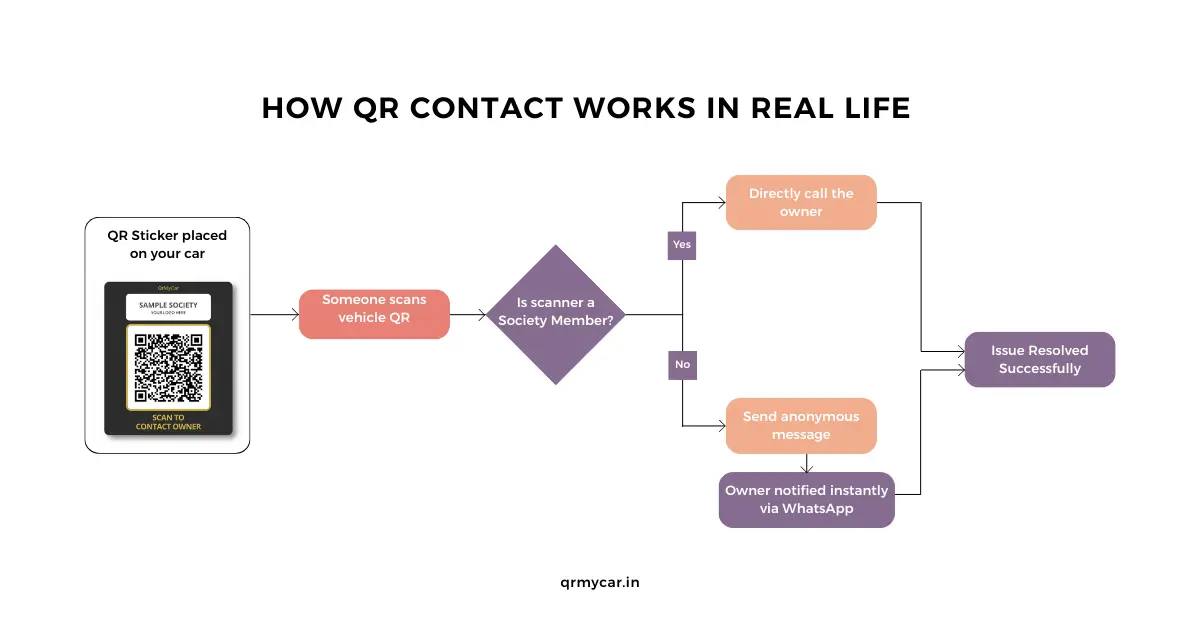
- Society members may call directly
- Outsiders can only send an anonymous message
- You get notified instantly, often on WhatsApp
This keeps control with the owner, not the caller. If you want a visual explanation, the below image shows the flow clearly.
When QR Contact Makes Sense (and How QrMyCar Fits)
At this stage, most people ask:
“Is this overkill for a simple parking problem?”
The answer depends on your situation.
For individual car owners
If you:
- Park in public or shared spaces
- Do not want your number exposed
- Still need to be reachable during emergencies
A QR sticker designed for cars is a clean replacement for number stickers.
With QrMyCar for individual vehicles:
- Your phone number is never displayed
- Outsiders can only send anonymous messages
- You receive WhatsApp notifications instantly
For gated societies
Societies face a bigger version of the same problem:
- Too many cars
- Too many conflicts
- Too many phone numbers floating around
QrMyCar stickers for societies provides QR stickers for each society vehicles. Society members can contact each other directly, while non-members can only send anonymous messages keeping the owners personal details private and safe.
In case you don't have a gate app already for your society, you may also think of getting society management system to manage residents and vehicles, guard workflows, visitor management, complaints, and notices stay organised without exposing personal details.
You can explore it further through our Society Management System.
So, should you put your phone number on your car?
If this were 2010, maybe.
In 2026, with privacy concerns, spam, and misuse becoming common, publicly displaying your number is a bigger risk than most people realize.
The better question to ask is:
“Can I stay reachable without staying exposed?”
If the answer matters to you, it is time to move beyond handwritten numbers and outdated stickers.
Final thought
Most people do not remove their phone number because of one bad experience. They remove it after many small, uncomfortable ones. If you can solve parking issues without sacrificing privacy, that is the better trade-off—and that is exactly what QrMyCar was built to deliver.
Need a privacy-first contact sticker for your car?
Order the QrMyCar QR sticker to stay reachable in any parking issue without revealing your phone number.
FAQ
Why do people put their phone number on their car and is it still a good idea?
Many owners add their phone number to avoid conflicts or move their vehicle quickly. While the intention is helpful, openly displaying your number invites spam, misuse, and unwanted late-night calls, making it an outdated solution in 2026.
What are the biggest risks of displaying my number publicly?
Anyone can photograph or share your number. That can lead to repeated calls, harassment, and zero control over who contacts you or why, especially when your vehicle is parked outside your society.
How does a QR-based contact sticker protect privacy?
A QR sticker lets someone scan the car and reach you through an anonymous channel, often via WhatsApp alerts. Your phone number stays hidden, so only genuine parking issues reach you.
Do I need an app to use QR contact stickers?
No. Scanners just use their phone camera, and you receive alerts instantly. Solutions like QrMyCar keep the flow simple for both society members and outsiders.
Can an entire society switch to QR-based contact?
Yes. QrMyCar offers QR stickers for each society member which allows other society members to call them directly while keeping the details private from outsiders.